theory

Sartre, it will be recalled, had asserted a kind of absolute freedom for the conscious human being. It was this claim that Merleau-Ponty disputed. […] If freedom were everywhere, as seemed to be the case in Sartre’s Being and Nothingness , then freedom in effect would be nowhere […] “Free action, in order to be discernible, has to stand out from a background of life from which it is entirely, or almost entirely, absent.” (Merleau-Ponty, Phenomenology of Perception, 1945) […]
While Sartre properly emphasized the subject’s freedom, he distorted the scope of this freedom by rendering it absolute. The subject, argued Merleau-Ponty, always faced a previously established situation, an environment and world not of its own making. Its life, as intersubjectively open, acquired a social atmosphere which it did not itself constitute. Social roles pressed upon the individual as plausible courses for his life to take. Certain modes of behavior became habitual. Probably , this world, these habits, a familiar comportment: probably these would not change overnight. It was unlikely that an individual would suddenly choose to be something radically other than what he had already become. The Sartre of Being and Nothingness underestimated the weight of this realm of relative constraint and habitual inertia.
{ Merleau-Ponty: The Ambiguity of History | Continue reading
Cognitive science is lacking conceptual tools to describe how an agent’s motivations, as such, can play a role in the generation of its behavior. […] a new kind of non-reductive theory is proposed: Irruption Theory. […] irruptions are associated with increased unpredictability of (neuro)physiological activity, and they should hence be quantifiable in terms of information-theoretic entropy. Accordingly, evidence that action, cognition, and consciousness are linked to higher levels of neural entropy can be interpreted as indicating higher levels of motivated agential involvement.
{ PsyArXiv | Continue reading }
controversy, ideas, theory | April 27th, 2023 6:35 am
Canada, one of the most real estate-obsessed nations on earth — and one of the least affected by the 2008 crash — is up 42+% in the past year alone.
Even in Ethiopia, where my wife grew up, a three-bedroom detached house in the capital can cost you $1+ million USD.
Until recently, most people’s house price paradigm looked something like this:
A house’s market price is the maximum amount that a buyer can expect to afford over the next 25–40 years. But because wages are flatlined and purchasing parity is the same as in 1978, the only rational explanation for this current price explosion is a giant debt bubble.
But what if the paradigm — the baseline assumption of what dictates house prices — is changing?
What if the newly-redefined value of shelter is the maximum amount of annual rent that can be extracted per unit of housing? […]
As reader Valerie Kittell put it: “Airbnb-type models altered the market irreversibly by proving on a large scale that short term rentals were more lucrative than stable long-term residents.”
We’re in the middle of a paradigm shift to corporate serfdom.
Stop enriching corrupt banks — pay off your mortgages and never look back. Parents and grandparents with means: Help your kids get a start in housing before it’s out of their reach forever.
{ Jared A. Brock | Continue reading }
housing, theory | June 18th, 2021 8:16 am
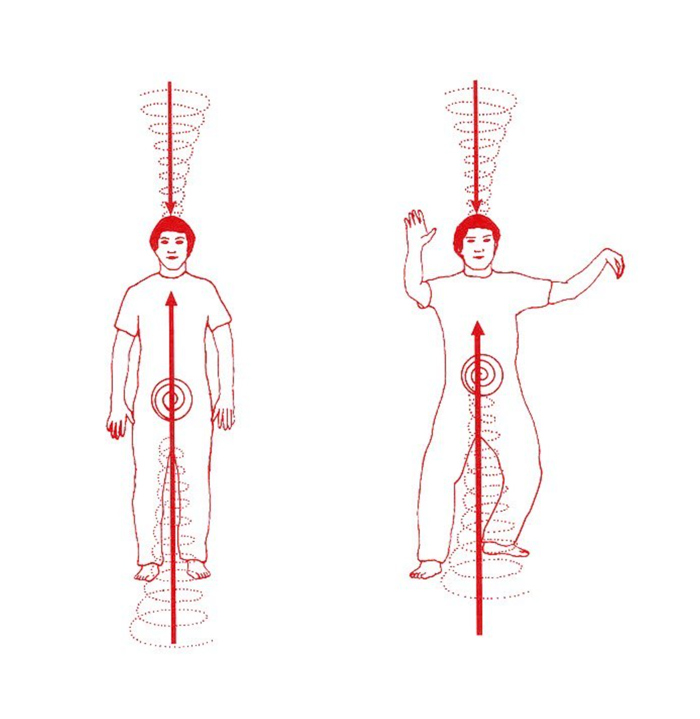
Say you travelled in time, in an attempt to stop COVID-19’s patient zero from being exposed to the virus. However if you stopped that individual from becoming infected, that would eliminate the motivation for you to go back and stop the pandemic in the first place. This is a paradox, an inconsistency that often leads people to think that time travel cannot occur in our universe. […] In the coronavirus patient zero example, you might try and stop patient zero from becoming infected, but in doing so you would catch the virus and become patient zero, or someone else would. No matter what you did, the salient events would just recalibrate around you. Try as you might to create a paradox, the events will always adjust themselves, to avoid any inconsistency.
{ Popular Mechanics | Continue reading | More: Classical and Quantum Gravity }
theory, time | September 27th, 2020 10:40 am
Moringa oleifera, an edible tree found worldwide in the dry tropics, is increasingly being used for nutritional supplementation. Its nutrient-dense leaves are high in protein quality, leading to its widespread use by doctors, healers, nutritionists and community leaders, to treat under-nutrition and a variety of illnesses. Despite the fact that no rigorous clinical trial has tested its efficacy for treating under-nutrition, the adoption of M. oleifera continues to increase. The “Diffusion of innovations theory” describes well the evidence for growth and adoption of dietary M. oleifera leaves, and it highlights the need for a scientific consensus on the nutritional benefits. […]
The regions most burdened by under-nutrition, (in Africa, Asia, Latin America, and the Caribbean) all share the ability to grow and utilize an edible plant, Moringa oleifera, commonly referred to as “The Miracle Tree.” For hundreds of years, traditional healers have prescribed different parts of M. oleifera for treatment of skin diseases, respiratory illnesses, ear and dental infections, hypertension, diabetes, cancer treatment, water purification, and have promoted its use as a nutrient dense food source. The leaves of M. oleifera have been reported to be a valuable source of both macro- and micronutrients and is now found growing within tropical and subtropical regions worldwide, congruent with the geographies where its nutritional benefits are most needed.
Anecdotal evidence of benefits from M. oleifera has fueled a recent increase in adoption of and attention to its many healing benefits, specifically the high nutrient composition of the plants leaves and seeds. Trees for Life, an NGO based in the United States has promoted the nutritional benefits of Moringa around the world, and their nutritional comparison has been widely copied and is now taken on faith by many: “Gram for gram fresh leaves of M. oleifera have 4 times the vitamin A of carrots, 7 times the vitamin C of oranges, 4 times the calcium of milk, 3 times the potassium of bananas, ¾ the iron of spinach, and 2 times the protein of yogurt” (Trees for Life, 2005).
Feeding animals M. oleifera leaves results in both weight gain and improved nutritional status. However, scientifically robust trials testing its efficacy for undernourished human beings have not yet been reported. If the wealth of anecdotal evidence (not cited herein) can be supported by robust clinical evidence, countries with a high prevalence of under-nutrition might have at their fingertips, a sustainable solution to some of their nutritional challenges. […]
The “Diffusion of Innovations” theory explains the recent increase in M. oleifera adoption by various international organizations and certain constituencies within undernourished populations, in the same manner as it has been so useful in explaining the adoption of many of the innovative agricultural practices in the 1940-1960s. […] A sigmoidal curve (Figure 1), illustrates the adoption process starting with innovators (traditional healers in the case of M. oleifera), who communicate and influence early adopters, (international organizations), who then broadcast over time new information on M. oleifera adoption, in the wake of which adoption rate steadily increases.
{ Ecology of Food and Nutrition | Continue reading }
Dendrology, economics, food, drinks, restaurants, theory | September 1st, 2020 4:54 pm
What is the feasibility of survival on another planet and being self-sustaining? […] I show here that a mathematical model can be used to determine the minimum number of settlers and the way of life for survival on another planet, using Mars as the example. […] The minimum number of settlers has been calculated and the result is 110 individuals.
{ Nature | Continue reading }
eschatology, theory | June 25th, 2020 7:55 am
The madman theory is a political theory commonly associated with U.S. President Richard Nixon’s foreign policy. He and his administration tried to make the leaders of hostile Communist Bloc nations think Nixon was irrational and volatile. According to the theory, those leaders would then avoid provoking the United States, fearing an unpredictable American response.
{ Wikipedia | Continue reading }
The author finds that perceived madness is harmful to general deterrence and is sometimes also harmful in crisis bargaining, but may be helpful in crisis bargaining under certain conditions.
{ British Journal of Political Science | Continue reading }
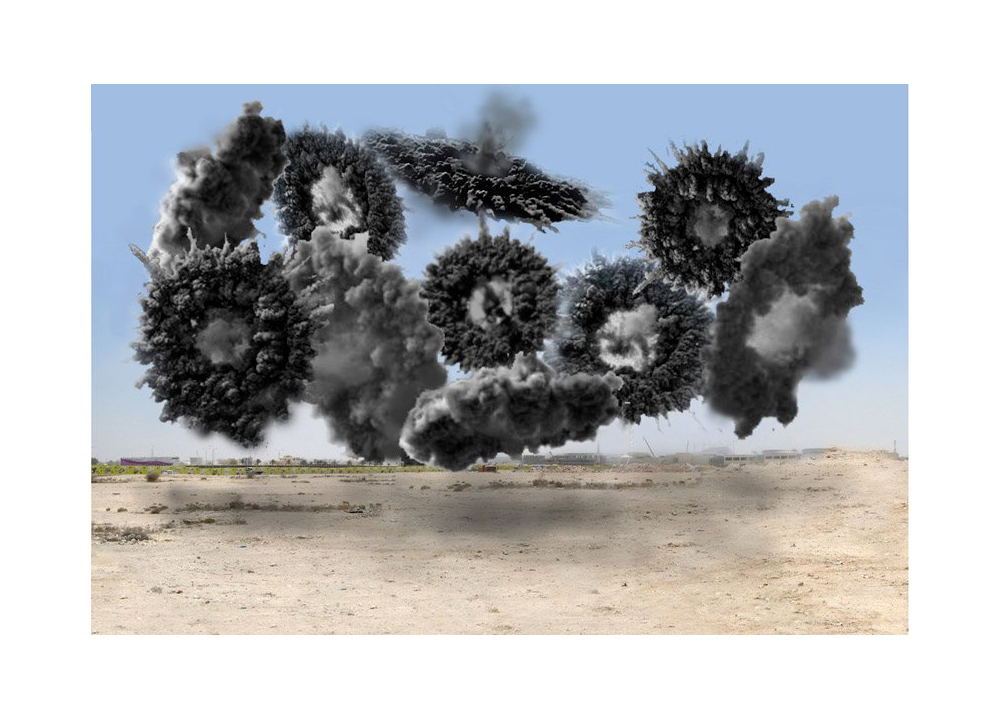
black smoke shells fitted with computer chips { Cai Guo-Qiang, Wreath (Black Ceremony), 2011 }
U.S., fights, theory | February 18th, 2020 4:47 pm
[W]hile time moves forward in our universe, it may run backwards in another, mirror universe that was created on the “other side” of the Big Bang.
{ PBS (2014) | Continue reading }
Physics, space, theory, time | January 23rd, 2020 6:54 pm

Ten years after the financial dramas of Autumn 2008, I take stock of what we have learned, what we have done, and what we have yet to do if we would avoid a repeat performance.
The primary lessons I draw are that income and wealth distribution, the endogeneity of credit-money, and finance system structure all matter profoundly not only where justice, but also where systemic stability is concerned.
The longer-term tasks still before us include a much broader and financially engineered diffusion of capital ownership over our population, citizen central banking, a permanent national investment authority, continuous public open labor market operations, debt-free or low-debt education and health insurance, and an updated form of segregating capital-raising primary from asset-trading secondary markets in the financial sector.
Shorter-term tasks include debt-forgiveness, a restoration of labor rights and countercyclical progressive taxation, and restored citizen-ownership of our secondary market makers in home mortgage and higher education debt.
{ LawArXiv | Continue reading }
U.S., economics, theory | March 12th, 2019 7:27 am
This paper approaches the subject of God or a supernatural being that created the universe from a mathematical and physical point of view. It sets up a hypothesis that when the God existed before the Big Bang as an unconscious being became conscious, the energy that was produced during the process became a both highly dense and infinite temperature Cosmic Egg and exploded to create the current universe. This assumption is demonstrated by mathematical formulas and physics law, which provide a solid scientific foundation for the aforementioned theory.
{ International Education and Research Journal | Continue reading }
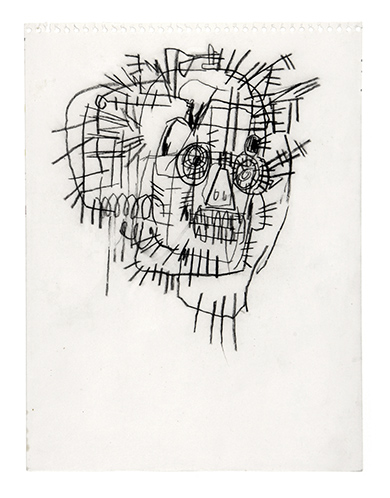
art { Jean-Michel Basquiat, Head, 1981 }
theory | October 31st, 2016 12:47 pm

Physicist Enrico Fermi famously asked the question “Where are they?” to express his surprise over the absence of any signs for the existence of other intelligent civilizations in the Milky Way Galaxy. […]
Observations have shown that the Milky Way contains no fewer than a billion Earth-size planets orbiting Sun-like (or smaller) stars in the “Goldilocks” region that allows for liquid water to exist on the planet’s surface (the so-called habitable zone). Furthermore, the search for extraterrestrial intelligent life has recently received a significant boost in the form of “Breakthrough Listen”—a $100-million decade-long project aimed at searching for non-natural transmissions in the electromagnetic bandwidth from 100 megahertz to 50 gigahertz.
Simple life appeared on Earth almost as soon as the planet cooled sufficiently to support water-based organisms. To be detectable from a distance, however, life has to evolve to the point where it dominates the planetary surface chemistry and has significantly changed the atmosphere, creating chemical “biosignatures” that can in principle be detected remotely. For instance, Earth itself would probably not have been detected as a life-bearing planet during the first two billion years of its existence. […]
[A]n excellent first step in the quest for signatures of simple extrasolar life in the relatively near future would be to: search for oxygen, but try to back it up with other biosignatures. […]
One would ideally like to go beyond biosignatures and seek the clearest sign of an alien technological civilization. This could be the unambiguous detection of an intelligent, non-natural signal, most notably via radio transmission, the aim of the SETI (Search for Extraterrestrial Intelligence) program. Yet there is a distinct possibility that radio communication might be considered archaic to an advanced life form. Its use might have been short-lived in most civilizations, and hence rare over large volumes of the universe. What might then be a generic signature? Energy consumption is a hallmark of an advanced civilization that appears to be virtually impossible to conceal. […]
More pessimistically, biologically-based intelligence may constitute only a very brief phase in the evolution of complexity, followed by what futurists have dubbed the “singularity”—the dominance of artificial, inorganic intelligence. If this is indeed the case, most advanced species are likely not to be found on a planet’s surface (where gravity is helpful for the emergence of biological life, but is otherwise a liability). But they probably must still be near a fuel supply, namely a star, because of energy considerations. Even if such intelligent machines were to transmit a signal, it would probably be unrecognizable and non-decodable to our relatively primitive organic brains.
{ Scientific American | Continue reading }
space, theory | January 13th, 2016 3:03 pm

In Women After All: Sex, Evolution, and the End of Male Supremacy, Melvin Konner argues that male domination is an anomaly of human history, not a natural state for the human species. Specifically, Konner suggests that male supremacy is largely an effect of an oppressive social arrangement, namely civilization, which began with the invention of agriculture when humans began to form permanent settlements. Permanent settlements enabled men to be able to accumulate resources and allowed population densities to increase mainly through higher birth rates. Higher population densities placed more intense pressure on the land’s resources. Therefore, it became necessary for men to form coalitions with neighbors to defend against intruders. Power became concentrated in the hands of a few men, leading to a stratified society where male supremacy and female subordination reigned and male violence and war intensified. Today, Konner argues that technology limits the need for the muscle and strength of men, and male domination has outlived its purpose and is maladaptive. Therefore, empowering women is the next step in human evolution. Through empowering women, equality between the sexes will be restored and man-made disasters, such as wars, sex scandals, and financial corruption, will significantly decrease or be eliminated since women (who Konner claims are less emotional than men) will be in positions of leadership and power.
{ Evolutionary Psychology | Continue reading }
evolution, flashback, theory | December 12th, 2015 9:40 am

Penrose and many others argue from practical considerations, Godel’s theorem, and on philosophical grounds, that consciousness or awareness is non-algorithmic and so cannot be generated by a system that can be described by classical physics, such as a conventional computer, but could perhaps be generated by a system requiring a quantum (Hilbert space) description. Penrose suspects that aspects of quantum physics not yet understood might be needed to explain consciousness. In this paper we shall see that only known quantum physics is needed to explain perception.
{ James A. Donald | Continue reading }
photo { Martin Parr }
Physics, mystery and paranormal, theory | December 3rd, 2015 1:40 pm

We now have four good Darwinian reasons for individuals to be altruistic, generous or ‘moral’ towards each other. First, there is the special case of genetic kinship. Second, there is reciprocation: the repayment of favours given, and the giving of favours in ‘anticipation’ of payback. Following on from this there is, third, the Darwinian benefit of acquiring a reputation for generosity and kindness. And fourth, if Zahavi is right, there is the particular additional benefit of conspicuous generosity as a way of buying unfakeably authentic advertising.
{ Richard Dawkins | Continue reading }
photo { Todd Fisher }
evolution, theory | November 13th, 2015 2:27 pm

An influential theory about the malleability of memory comes under scrutiny in a new paper in the Journal of Neuroscience.
The ‘reconsolidation’ hypothesis holds that when a memory is recalled, its molecular trace in the brain becomes plastic. On this view, a reactivated memory has to be ‘saved’ or consolidated all over again in order for it to be stored.
A drug that blocks memory formation (‘amnestic’) will, therefore, not just block new memories but will also cause reactivated memories to be forgotten, by preventing reconsolidation.
This theory has generated a great deal of research interest and has led to speculation that blocking reconsolidation could be used as a tool to ‘wipe’ human memories.
However, Gisquet-Verrier et al. propose that amnestic drugs don’t in fact block reconsolidation, but instead add an additional element to a reactivated memory trace. This additional element is a memory of the amnestic itself – essentially, ‘how it feels’ to be intoxicated with that drug.
In other words, the proposal is that amnestics tag memories with ‘amnestic-intoxication’ which makes these memories less accessible due to the phenomenon of state dependent recall. This predicts that the memories could be retrieved by giving another dose of the amnestic.
So, Gisquet-Verrier et al. are saying that (sometimes) an ‘amnestic’ drug can actually improve memory.
{ Neuroskeptic | Continue reading }
related { Kids can remember tomorrow what they forgot today }
memory, theory | September 22nd, 2015 2:41 pm

Dogs can infer the name of an object and have been shown to learn the names of over 1,000 objects. Dogs can follow the human pointing gesture; even nine week old puppies can follow a basic human pointing gesture without being taught.
New Guinea Singing dogs, a half-wild proto-dog endemic to the remote alpine regions of New Guinea, as well as Dingoes in the remote outback of Australia are also capable of this.
These examples demonstrate an ability to read human gestures that arose early in domestication and did not require human selection. “Humans did not develop dogs, we only fine-tuned them down the road.”
Similar to the chimpanzee, Bonobos are a close genetic cousin to humans. Unlike the chimpanzee, bonobos are not aggressive and do not participate in lethal intergroup aggression or kill within their own group. The most distinctive features of a bonobo are its cranium, which is 15% smaller than a chimpanzee’s, and its less aggressive and more playful behavior. Dogs mirror these differences relative to wild wolves: a dog’s cranium is 15% smaller than an equally heavy wolf’s, and the dog is less aggressive and more playful. The guinea pig’s cranium is 13% smaller than its wild cousin the cavie and domestic fowl show a similar reduction to their wild cousins. Possession of a smaller cranium for holding a smaller brain is a telltale sign of domestication. Bonobos appear to have domesticated themselves.
In the “farm fox” experiment, humans selectively bred foxes against aggression which caused a domestication syndrome. The foxes were not selectively bred for smaller craniums and teeth, floppy ears, or skills at using human gestures but these traits were demonstrated in the friendly foxes.
Natural selection favors those that are the most successful at reproducing, not the most aggressive. Selection against aggression made possible the ability to cooperate and communicate among foxes, dogs and bonobos. Perhaps it did the same thing for humans.
{ Wikipedia | Continue reading }
animals, flashback, theory | August 6th, 2015 11:00 am

15 years ago, the neurosciences defined the main function of brains in terms of processing input to compute output: “brain function is ultimately best understood in terms of input/output transformations and how they are produced” wrote Mike Mauk in 2000.
Since then, a lot of things have been discovered that make this stimulus-response concept untenable and potentially based largely on laboratory artifacts.
For instance, it was discovered that the likely ancestral state of behavioral organization is one of probing the environment with ongoing, variable actions first and evaluating sensory feedback later (i.e., the inverse of stimulus response). […]
In humans, functional magnetic resonance imaging (fMRI) studies over the last decade and a half revealed that the human brain is far from passively waiting for stimuli, but rather constantly produces ongoing, variable activity, and just shifts this activity over to other networks when we move from rest to task or switch between tasks.
{ Björn Brembs | Continue reading }
neurosciences, theory | March 27th, 2015 12:30 pm
No Big Bang? Quantum equation predicts universe has no beginning
The widely accepted age of the universe, as estimated by general relativity, is 13.8 billion years. In the beginning, everything in existence is thought to have occupied a single infinitely dense point, or singularity. Only after this point began to expand in a “Big Bang” did the universe officially begin.
Although the Big Bang singularity arises directly and unavoidably from the mathematics of general relativity, some scientists see it as problematic because the math can explain only what happened immediately after—not at or before—the singularity.
{ Phys.org | Continue reading }
Hilbert managed to build a hotel with an infinite number of rooms, all of which are occupied.
Suppose a new guest arrives and wishes to be accommodated in the hotel. Because the hotel has an infinite number of, we can move any guest occupying any room n to room n+1 (the occupant of room 1 moves to room 2, room 2 to room 3, and so on), then fit the newcomer into room 1.
Now suppose an infinite number of new guests arrives: just move any occupant of room n to room 2n (room 1 to room 2, room 2 to room 4, room 3 to room 6, and so on), and all the odd-numbered rooms (which are countably infinite) will be free for the new guests.
{ Wikipedia | Continue reading }
ideas, space, theory | February 9th, 2015 1:11 pm

New theories suggest the big bang was not the beginning, and that we may live in the past of a parallel universe.
[…]
Time’s arrow may in a sense move in two directions, although any observer can only see and experience one.
{ Scientific American | Continue reading }
photo { Tania Shcheglova and Roman Noven }
Physics, photogs, theory, time | December 9th, 2014 3:05 pm

Crimes such as bribery require the cooperation of two or more criminals for mutual gain. Instead of deterring these crimes, the state should disrupt them by creating distrust among criminals so they cannot cooperate. In a cooperative crime with two criminals, the state should offer amnesty and a bounty to the criminal who first secures punishment of the other criminal. When the bounty exceeds the bribe, a bribed official gains less from keeping the bribe than from confessing and receiving the bounty. Consequently the person who pays the bribe cannot trust the person who takes it. The game’s unique equilibrium is non-cooperative and bribes disappear.
{ Review of Law & Economics }
economics, law, theory | November 12th, 2014 4:26 pm

For centuries, scientists studied light to comprehend the visible world. […] But in the late 19th century all that changed […] the whole focus of physics—then still emerging as a distinct scientific discipline—shifted from the visible to the invisible. […] Today its theories and concepts are concerned largely with invisible entities: not only unseen force fields and insensible rays but particles too small to see even with the most advanced microscopes. […] Theories at the speculative forefront of physics flesh out this unseen universe with parallel worlds and with mysterious entities named for their very invisibility: dark matter and dark energy. […]
…the concept of “brane” (short for membrane) worlds. This arises from the most state-of-the-art variants of string theory, which attempt to explain all the known particles and forces in terms of ultra-tiny entities called strings, which can be envisioned as particles extended into little strands that vibrate. Most versions of the theory call for variables in the equations that seem to have the role of extra dimensions in space, so that string theory posits not four dimensions (of time and space) but 11. As physicist and writer Jim Baggott points out, “there is no experimental or observational basis for these assumptions”—the “extra dimensions” are just formal aspects of the equations. However, the latest versions of the theory suggest that these extra dimensions can be extremely large, constituting extra-dimensional branes that are potential repositories for alternative universes separated from our own like the stacked leaves of a book. Inevitably, there is an urge to imagine that these places too might be populated with sentient beings, although that’s optional. The point is that these brane worlds are nothing more than mathematical entities in speculative equations, incarnated, as it were, as invisible parallel universes. […]
Scientists, of course, are not just making things up, while leaning on the convenience of supposed invisibility. They are using dark matter and dark energy, and (if one is charitable) quantum many-worlds and branes, and other imperceptible and hypothetical realms, to perform an essential task: to plug gaps in their knowledge with notions they can grasp.
{ Nautilus | Continue reading }
related { How it works: An ultra-precise thermometer made from light }
Physics, theory | June 11th, 2014 2:10 pm


